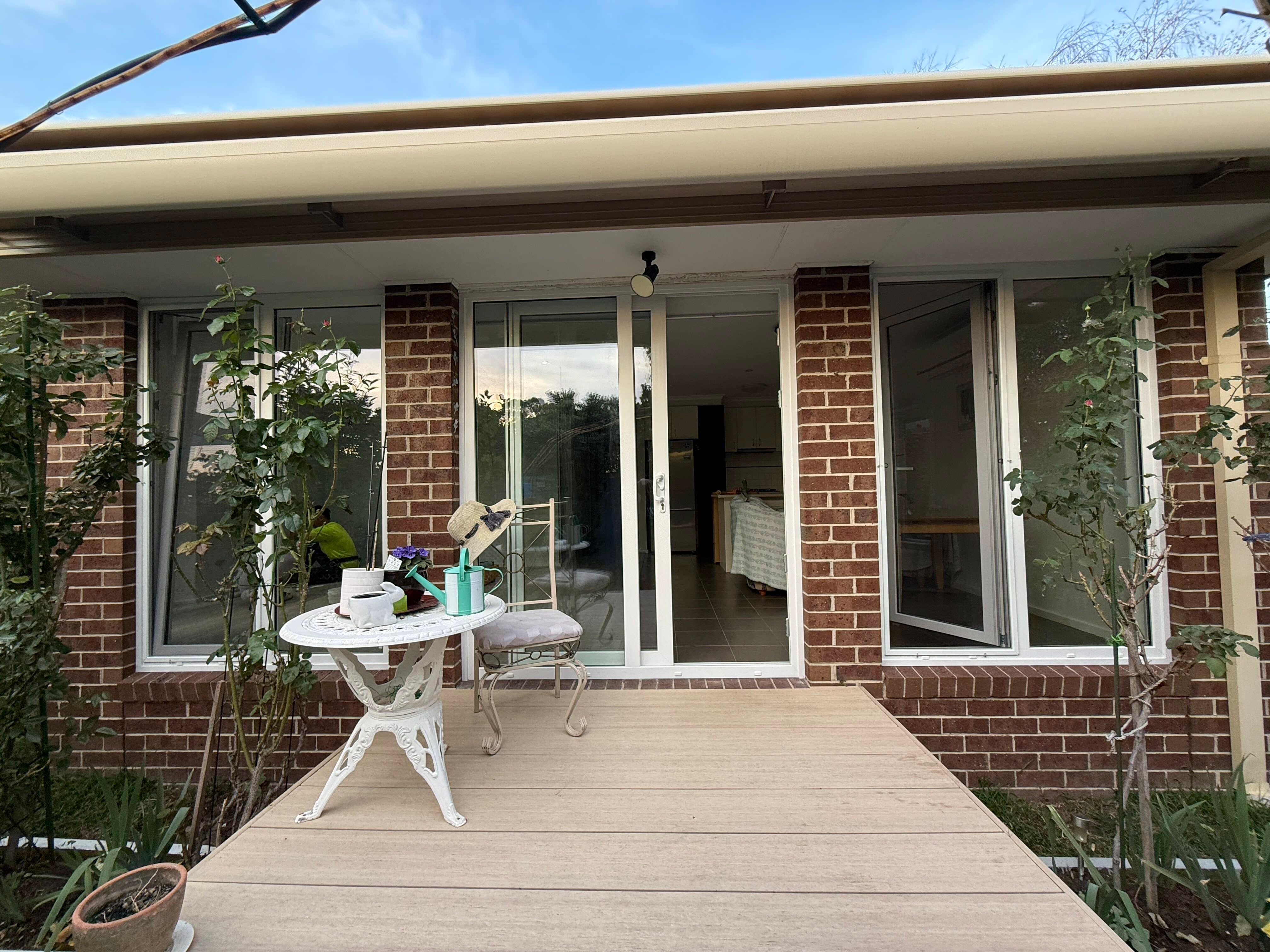
What uPVC actually is, how it differs from PVC, why Australian-grade profiles aren’t the same as European ones, and the technical specs that separate a 30-year window from a 15-year one. Written by a Melbourne uPVC manufacturer, with the unglamorous details most marketing pages skip.



uPVC (unplasticised polyvinyl chloride) is a rigid, weather-resistant polymer used for window and door frames. Unlike standard PVC, uPVC contains no plasticisers, so it stays dimensionally stable for decades without softening, warping, or leaching. A modern uPVC double glazed window achieves a whole-window U-value of around 1.8 W/m²K (WERS-rated), conducts heat at roughly 1/1,000th the rate of aluminium, and lasts 30+ years with no painting or sealing. uPVC is the standard window frame material across Europe and is now Australia’s fastest-growing residential frame option under NCC 2025 energy targets.
uPVC stands for unplasticised polyvinyl chloride. It is a rigid, weather-resistant polymer engineered for structural applications: window frames, door frames, plumbing, electrical conduit, and exterior cladding. The “u” (unplasticised) is the critical part: this is the same base polymer family as PVC, but with no added plasticisers. The absence of plasticisers is what makes uPVC behave like a structural material rather than a flexible one.
For windows specifically, uPVC profiles are produced by extruding a precise compound of PVC resin, calcium-zinc stabilisers, titanium dioxide, impact modifiers, and processing aids through a heated die. The result is a multi-chamber hollow profile. The internal chambers trap still air, which acts as the thermal break. Separate dedicated channels run the length of the profile for the galvanised steel reinforcement insert, drainage paths, and hardware mounting. A typical uPVC window frame is between 60 mm and 80 mm deep, with five air chambers and a design service life of 30+ years.
uPVC has been the standard residential window frame in Germany since the 1960s, in the UK since the 1980s, and in continental Europe broadly since the 1990s. Australian adoption lagged because of cheap, widely-available aluminium and a residential building code that didn’t price energy performance until NCC 2025. That has now changed. Every new home in Victoria built after May 2024 must achieve a 7-star NatHERS rating, and uPVC is one of the few frame materials that hits the required whole-window U-values without needing exotic glazing upgrades.
Buyers regularly ask “is uPVC just plastic?” or “isn’t this the same stuff as the white PVC pipes on a worksite?”. The short answer is no. uPVC and PVC share a base polymer but are different engineered materials with different mechanical, thermal, and chemical properties. The pipes you see on a building site are typically uPVC too, just formulated for fluid containment rather than glazing. Here is the practical version:
| Property | PVC (plasticised) | uPVC (unplasticised) |
|---|---|---|
| Plasticiser content | 10–40% by mass | 0% (none added) |
| State at room temperature | Flexible | Rigid |
| Tensile strength (typical) | 10–25 MPa | 50–55 MPa |
| Common applications | Vinyl flooring, cable insulation, hose, inflatable products, medical tubing | Window frames, door frames, drainage pipes, exterior cladding, conduit |
| UV stability | Variable, plasticisers can leach | High when properly stabilised |
| Service life (window/door) | Not used structurally | 30+ years |
| Recyclable | Limited | ✔ 7–10 cycles |
Reputable Australian uPVC fabricators source from named European extruders (Deceuninck, Rehau, Veka, Kömmerling, Aluplast, Schüco) and can produce extruder data sheets on request. If a supplier cannot tell you whose profile they are using or whose compound formulation they buy, that is a meaningful red flag.
A uPVC profile sold in Europe and a uPVC profile sold in Melbourne are not the same compound. The base resin is identical; the additive package is materially different. Australian uPVC profiles are formulated to survive UV intensity, summer surface temperatures, and coastal salt exposure that European profiles never need to handle. The differences are invisible at delivery and only show up after years of service. Here is what changes.
Titanium dioxide (TiO₂) is the white pigment that prevents UV-induced photodegradation of the polymer chain. Without enough TiO₂, the surface yellows over years and the polymer becomes increasingly brittle. European uPVC profiles typically use 5–7% TiO₂ by mass. Australian-formulated profiles, including Deceuninck’s Legend Art system used by Windows Republic, target approximately 9% TiO₂ by mass. The higher loading reflects the simple physics: solar UV irradiance in Melbourne averages around 5.0 kWh/m²/day in summer, compared to roughly 3.5 kWh/m²/day across northern Europe. More UV demands more pigment shielding.
Older uPVC formulations used lead-based stabilisers (lead stearate or lead sulphate) to prevent thermal degradation during extrusion and across the service life. The European industry voluntarily phased out lead stabilisers under VinylPlus 2010, completing the transition by 2015. Modern Deceuninck-grade uPVC is stabilised with calcium-zinc compounds, which are non-toxic, food-contact safe, and recyclable without contamination. If you are buying uPVC windows, the stabiliser chemistry should be calcium-zinc. Ask for confirmation.
Black, anthracite grey, and woodgrain-foiled uPVC sashes absorb significantly more solar radiation than white profiles and run noticeably hotter in direct Australian summer sun. Standard uPVC formulations were originally optimised for the lighter colours that dominated the European market. Modern dark-colour uPVC profiles, including Deceuninck’s woodgrain and dark-foil range, use a compound formulated to maintain dimensional stability and surface integrity at the higher temperatures dark frames experience. The practical result: you can specify a black or anthracite Australian-grade uPVC frame and trust it to behave dimensionally over the long term, where the same colour in a generic compound may not.
Every uPVC frame contains a galvanised steel reinforcement insert running through the largest internal chamber. The insert handles wind-load and self-weight forces that uPVC alone cannot, while the uPVC handles the thermal and weather work. Steel gauge varies by system type rather than climate zone: sliding-sash systems are reinforced with 2 mm steel, tilt & turn systems start from 1.5 mm, and casement and awning systems sit between the two. This is why a “heavier” window isn’t inherently better; it is engineered to the loads its specific configuration sees. When evaluating a uPVC window, ask the supplier which AS 2047 wind-load rating the system is certified to and what steel insert it carries.
Most of what determines how a uPVC window performs over decades is invisible from outside. It sits in the cross-section of the profile. A modern Deceuninck Legend Art profile, the system Windows Republic uses, is a multi-chamber extrusion with five sealed air chambers and a galvanised steel reinforcement insert. That cross-section is what determines the thermal performance, the structural strength, the acoustic damping, and the long service life. The sections below describe what each part of the cross-section does and why it is built that way.
Each chamber is a sealed pocket of still air inside the frame. Still air has a thermal conductivity of around 0.026 W/m·K, lower than most solid building materials, which is why trapping it in sealed pockets is one of the most effective passive insulation techniques available. The chambers do three things at once:
UK profiles often use 6 or 7 chambers because the UK demands lower U-values than Australia. AU 5-chamber is the engineered sweet spot for our climate: enough thermal resistance to hit NCC 2025 targets without the additional cost and weight of UK-spec extrusions.
Inside the largest chamber is a square-section galvanised steel insert. uPVC alone is not strong enough to resist sustained wind load on a large frame, so the steel does the structural work and the uPVC does the thermal and weather work. The two materials are bonded mechanically, not chemically, which lets each one do what it is good at without compromising the other.
This is where uPVC quietly outperforms aluminium and timber. Aluminium frame corners are typically mitered and screwed (or crimped). Timber frame corners are joined with mortise-and-tenon or dowel joinery. uPVC frame corners are fusion-welded at approximately 245°C. The two profile ends are heated to a controlled molten state and pressed together; the polymer chains cross-fuse, cool as one continuous piece, and the corner becomes mechanically stronger than the surrounding profile. There are no fasteners, no gaskets, no screws to loosen, no joinery to fail. A welded uPVC corner is a single material continuum.
Legend Art profiles use two different elastomer compounds for the perimeter and glazing-bead seals:
Both are tested to AS 2047 for water penetration and air infiltration. Both are field-replaceable in the unlikely event of damage, without removing the frame from the wall.
The European EN 12608 standard classifies uPVC profiles by visible-wall thickness. Both Class A and Class B are engineered structural profiles, suitable for residential window manufacture, and both can be specified to deliver the wind-load and acoustic ratings required under AS 2047.
The headline class designation is one input; whole-system performance (U-value, wind-load rating, acoustic Rw, lifecycle testing) is what determines whether a window is fit for purpose. When evaluating a uPVC window, ask the supplier for the system’s WERS rating and AS 2047 certification rather than the wall class alone.
uPVC manufacturers throw a lot of numbers at buyers. Most of those numbers are real, but only some of them are decision-relevant. Here is the short list, what each one means in practice, and what to look for.
You will see three separate U-values in glazing technical literature: Ug (centre-of-glass), Uf (frame), and Uw (whole window). Some suppliers quote Ug only because it is the lowest of the three and reads best on a brochure. NCC 2025 specifies whole-window U-value (Uw), which is the area-weighted average of frame, glass, and the linear thermal transmittance of the spacer between the two glass panes (Ψ value). A glazing unit with a 1.0 W/m²K Ug in an aluminium frame can have a Uw of 4.0 W/m²K because the frame ruins the average. The same glazing unit in a uPVC frame yields a Uw of around 1.4 W/m²K. The frame matters more than buyers realise. Always ask for Uw when comparing quotes.
AS 2047 tests windows for air infiltration under pressure differential. uPVC double glazed windows, with a multi-point locking system, perimeter compression gasket, and fusion-welded corners, typically test well under the AS 2047 threshold and are noticeably tighter than a typical aluminium sliding window. The practical effect is that a uPVC-fitted home feels noticeably quieter on a windy day and holds heating or cooling longer after the system cycles off.
Wind-load classifications under AS 2047 (N1 through N6) describe how much wind pressure a building element must withstand. Each uPVC window system is independently tested and certified to a specific wind-load class. Once certified, the system can be specified for any site rated at or below that class. Melbourne sits well within the residential range (typically N2–N3) for which all standard uPVC systems Windows Republic supplies are fully certified. If a supplier cannot state the AS 2047 wind-load rating their system is certified to, the certification probably doesn’t exist.
Bushfire Attack Level (AS 3959) classifies how much radiant heat a building element must survive in a bushfire event. Ratings run from BAL-Low up through BAL-12.5, BAL-19, BAL-29, BAL-40, and BAL-FZ (Flame Zone). Windows Republic uPVC windows are BAL-40 compliant, meaning they survive radiant heat exposure up to 40 kW/m². This covers most Victorian fringe locations including the Dandenongs, Yarra Valley, and the eastern bushfire fringe. BAL-FZ requires a different specification (steel-shuttered or specially intumescent-glazed) and is uncommon in most residential builds.
The full head-to-head comparison lives in our uPVC vs Aluminium Double Glazed Windows guide. The summary is below for context. uPVC outperforms aluminium decisively on thermal insulation, acoustic damping, salt-air durability, and lifetime maintenance cost. Aluminium retains a structural advantage at very large unsupported spans, very narrow sightlines, and most commercial applications. For 95% of Melbourne residential window jobs, uPVC is the right answer.
| Factor | uPVC | Aluminium |
|---|---|---|
| Thermal performance (Uw) | ✔ 1.1–1.8 W/m²K | ✘ 4.5–6.0 W/m²K (non-thermally-broken) |
| Frame thermal conductivity | 0.17 W/m·K | ~200 W/m·K (1,000× higher) |
| Acoustic Rw (with same glass) | 4–6 dB better than aluminium | Standard baseline |
| Salt corrosion | ✔ Immune | ✘ Vulnerable without anodising |
| Lifetime maintenance | Wipe clean, no painting | Periodic anodising or repainting |
| Service life | 30+ years | 20–30 years |
| Best application | 95% of Melbourne residential | Ultra-narrow sightlines, very large spans, most commercial |
For the full comparison including pricing, sliding-door specifics, and the cases where aluminium is genuinely the right call, read our uPVC vs Aluminium guide.
The Deceuninck Legend Art system Windows Republic uses can be configured into all common operable styles plus fixed configurations. Each style serves a specific role:
All styles share the same Legend Art profile system, the same five-chamber thermal break, and the same Australian-grade compound. The difference between styles is purely hardware.
This is where most buyer guides drop honesty in favour of a sales pitch. uPVC is excellent for the great majority of Australian residential applications, but it is not always the right call. The honest version:
For most Australian homes outside those specific scenarios, uPVC is the right answer. We say that as a uPVC manufacturer, but we say it after personally surveying hundreds of Melbourne homes with both materials in service.
uPVC double glazed windows in Australia cost approximately $2,200+ per window fully installed for smaller sizes, or $1,200+ per square metre for medium-to-large windows. A whole-home replacement across a 3-bedroom house typically costs $15,000–$40,000+ depending on window count, sizes, frame colour, and glass specification. These are 2026 Australian dollars, fully installed by Windows Republic. The per-window figures reflect multi-window jobs; single-window installations carry higher per-unit pricing because fixed installation, travel, and handling costs apply regardless of count.
Full per-style breakdown, building-type adjustments, and the line-by-line factors that move a quote up or down are on the dedicated Melbourne uPVC Window Cost Guide. Custom colours and acoustic laminated glass typically add 10–15%; triple glazing adds a further 10–15% over double.
True for 1990s-formulation uPVC sold without proper UV stabilisation. False for modern Australian-grade profiles. Yellowing is caused by UV-induced photo-oxidation of the polymer chain, which is exactly what titanium dioxide pigment and Ca-Zn stabilisers are formulated to prevent. Modern Deceuninck profiles installed in Australia in 2010 still test within original colour tolerance today. The myth largely persists through word-of-mouth and a small number of early-formulation profiles still in service; the current product behaves very differently.
This depends almost entirely on which profile system you are looking at. Premium European systems are engineered for contemporary architectural aesthetics: hidden hardware, slim sight lines, concealed drainage, near-flush sash-to-frame transitions, and a colour palette including anthracite grey, ash black, woodgrain foils, and dual-colour combinations (different colour inside vs outside).
Selectively true and selectively false. uPVC is a petrochemical-derived polymer, which has a real embodied energy cost. By embodied carbon per kilogram of frame material, uPVC sits below aluminium (which is energy-intensive to smelt) and well below steel; broadly comparable to or slightly above engineered timber depending on the timber source and treatment chemistry. Where uPVC is decisively strong is the use phase: it is recyclable 7–10 times without significant degradation, lasts 30+ years per service cycle, and reduces lifetime heating and cooling energy compared to single-glazed alternatives. Lifecycle analysis for uPVC double glazed windows in heating-dominated climates shows the operational energy savings recover the embodied carbon penalty over the early years of service and continue to outperform thereafter, with the exact crossover depending on climate, glazing spec, and the comparison baseline. The honest answer is that the environmental case is genuinely strong, but only if the windows are sourced from a legitimate extruder and eventually recycled through the established uPVC recycling stream.
uPVC is self-extinguishing once the ignition source is removed; the flame-retardant chemistry is built into the polymer. Look for a uPVC window system tested and certified to BAL-40 under AS 3959 (bushfire radiant heat at 40 kW/m²). Windows Republic uPVC profiles meet that rating, which covers most Victorian fringe locations including the Dandenongs, Yarra Valley, and the eastern bushfire fringe. BAL-FZ (Flame Zone, the most extreme bushfire classification) requires a different glazing-and-frame system regardless of frame material; very few residential homes are built in BAL-FZ.
This is half-true at the material level and false at the system level. Pure uPVC is less stiff than pure aluminium, which is exactly why uPVC frames carry a galvanised steel reinforcement insert. The composite uPVC plus steel system is engineered to handle the same wind-load and self-weight forces a comparable aluminium frame handles, and is independently certified to AS 2047. What changes is the visible frame width: aluminium can deliver narrower sightlines because its raw stiffness is higher, while uPVC trades a slightly wider frame for far better thermal and acoustic performance.

Vladimir founded Windows Republic in Cheltenham, Victoria in 2016 and has personally overseen the company’s uPVC window manufacturing and installation across Melbourne. With a Bachelor of Business & Commerce, an MBA, and more than a decade specialising in European uPVC window systems, he has direct technical experience with Deceuninck Legend Art profiles, fusion-welded corner manufacturing, and Australian wind-load and bushfire compliance. Every Windows Republic frame is fabricated in-house in Cheltenham, glazed on site, and installed by Windows Republic’s own crew, with no subcontractors.
First published: 10 May 2026 ·
Last reviewed for accuracy: 10 May 2026.
All technical specifications, performance figures, and compound chemistry references reflect Windows Republic’s current 2026 manufacturing data. Technical claims are cross-referenced against
NCC 2022 (Vol. 2),
AS 2047:2014,
WERS, and Deceuninck’s published Legend Art technical documentation.
uPVC is unplasticised polyvinyl chloride. The compound is approximately 80–85% PVC resin, with the remainder being calcium-zinc thermal stabilisers, titanium dioxide UV-blocking pigment (around 9% in Australian-grade profiles), impact modifiers, and processing aids. It contains no plasticisers (no phthalates), which is what makes it rigid rather than flexible. Modern Australian-grade uPVC is lead-free and food-contact safe.
No. uPVC and PVC share the same base polymer but are different engineered materials. PVC contains plasticisers (typically 10–40% by mass) which make it flexible, used for vinyl flooring and cable insulation. uPVC contains no plasticisers, which keeps it rigid and structurally stable. uPVC is the correct material for window frames, drainage pipes, and exterior cladding; standard PVC is not used structurally.
Quality uPVC windows last 30 years or more in Australian conditions when manufactured with Australian-grade compound (approximately 9% titanium dioxide and calcium-zinc stabilisers). Windows Republic backs the uPVC frame with a 10-year manufacturer’s warranty and 7 years on the sealed double glazed unit (IGU). Hardware (Siegenia and Roto mechanisms) is rated for 50,000+ open-close cycles. Modern uPVC profiles installed in Australia in 2010 are still testing within original colour and dimensional tolerances today.
Yes, when the profile is formulated for Australian conditions. Australian-grade uPVC profiles use higher titanium dioxide loading (around 9% vs 5–7% European) for UV resistance, calcium-zinc stabilisers, and a heat-modified compound for darker colours that maintains dimensional stability under direct Australian summer sun. uPVC is immune to salt corrosion, certified to BAL-40 for bushfire zones, and delivers whole-window U-values of 1.1–1.8 W/m²K which meets NCC 2025 7-star NatHERS targets in Melbourne.
Yes, 7 to 10 times without significant degradation. uPVC profiles can be granulated, re-extruded, and used in new profile cores or non-visible structural applications. Deceuninck operates a closed-loop uPVC recycling stream in Europe (Recom system) and similar industry-led recycling schemes are emerging in Australia. Lifecycle analysis for uPVC double glazed windows in heating-dominated climates shows the operational energy savings recover the embodied carbon penalty over the early years of service and continue to outperform thereafter.
uPVC double glazed and standard thermally-broken aluminium double glazed are roughly comparable in upfront cost. uPVC is significantly cheaper than premium thermally-broken aluminium with high-performance glazing, and significantly more expensive than basic single-glazed aluminium. Over a 25-year lifetime, uPVC is cheaper overall once energy savings, zero maintenance costs, and longer service life are factored in. Full pricing breakdown is on our cost guide.
Yes. Solid colours include white, cream, silver grey, anthracite grey, and ash black. Woodgrain foils include golden oak, hazelnut, and walnut. Dual-colour orders (one colour internally, another externally) are common, including the popular cream-on-white combination for heritage facades. Darker colours use a heat-modified compound that maintains dimensional stability under direct Australian summer sun, a formulation not always specified in cheaper import profiles.
Yes, safe. No, they do not contain lead when sourced from a reputable European extruder. The European industry voluntarily phased out lead stabilisers in uPVC under the VinylPlus 2010 commitment, completing the transition by 2015. Modern Deceuninck-grade uPVC, used by Windows Republic, is stabilised with calcium-zinc compounds: non-toxic, food-contact safe, and recyclable without contamination. uPVC is also self-extinguishing under fire and certified to BAL-40 under AS 3959 for bushfire radiant heat. If a supplier cannot confirm calcium-zinc stabiliser chemistry, ask for the extruder data sheet.
Australian-grade Deceuninck Legend Art profiles, fabricated in Cheltenham, fully installed by the Windows Republic crew. Free measure and quote, no obligation.
Technical performance figures, compound chemistry, and compliance claims in this article cite the following authoritative sources:
Compound formulation references (titanium dioxide loading, calcium-zinc stabilisers, heat-modified dark-colour compounds) reflect Deceuninck’s published Australian-grade Legend Art specifications and Windows Republic’s in-house manufacturing data, 2024–2026. Pricing ranges are indicative and subject to a free on-site measure and quote.

We'll respond via email within 24 hours
We'll be in touch within 24 hours.
This window will close automatically
