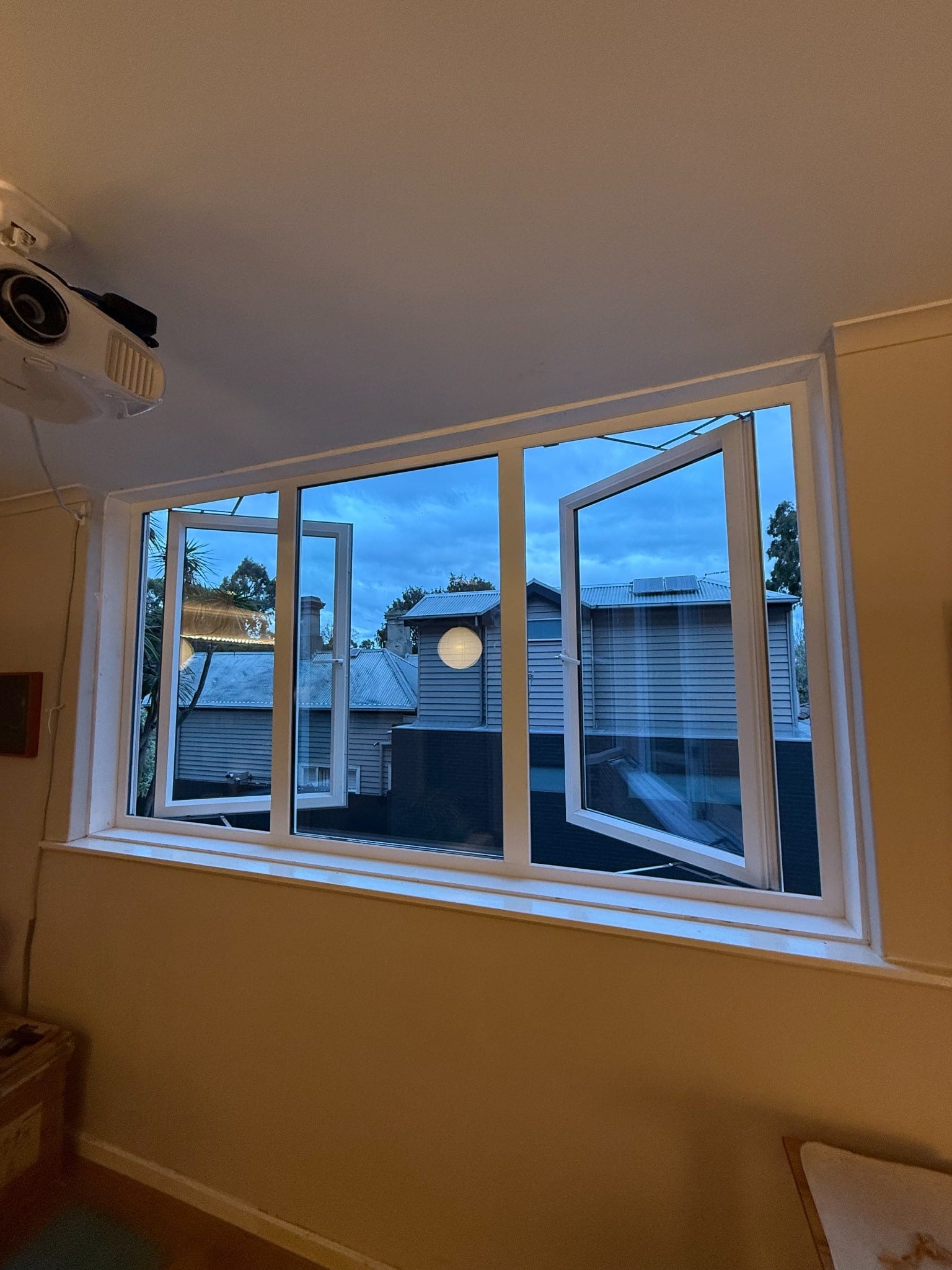
Australia’s two most popular operable window styles, compared head-to-head across uPVC, aluminium, and timber. Real Melbourne pricing, rain-safe ventilation, double glazing performance, and how to choose the right style for each room in your home.



Awning windows are hinged at the top and open outward from the bottom; casement windows are hinged at the side and swing fully outward like a door. They are Australia’s two most popular operable window opening styles, and in Melbourne’s climate a uPVC double glazed version of either reaches a whole-window U-value of about 1.8 W/m²K (WERS-rated), roughly three times the thermal performance of a standard single-glazed aluminium window. This guide compares them head-to-head across frame materials, ventilation, rain performance, security, and real 2026 Melbourne pricing.
An awning window is a top-hinged window that opens outward from the bottom. When open, the sash angles downward, and the glass itself acts as a shield that deflects light rain away from the opening, so an awning window can stay open during a light shower. This rain-safe geometry is why an awning window is the default choice for bathrooms, kitchens, laundries, and any room where continuous ventilation matters.
Windows Republic awning windows use a premium push-out handle rather than a winder or crank. A single unlatching motion releases the multi-point locks; the sash is pushed out by hand and held at a chosen angle by stainless-steel friction stays. Fewer moving parts, a tighter compression seal when closed, and no gearbox to service over the life of the window.
Modern awning windows are available in uPVC, aluminium, and timber frames. Of these, uPVC double glazed awning windows deliver the best thermal performance and the lowest lifetime maintenance cost, a decisive advantage in Melbourne’s variable climate, where a frame can face 5°C winter mornings and 40°C summer afternoons in the same week.
A casement window is a side-hinged window that swings fully outward like a door. Because the whole sash clears the frame when opened, a casement window delivers the greatest airflow through a single opening, which is the reason it is the default Melbourne choice for living rooms, bedrooms, and home offices where peak ventilation and an unobstructed glass view matter most.
Windows Republic uPVC casement windows use a premium push-out handle driving multi-point locking hardware: a single lift of the handle engages or releases locking bolts simultaneously around the frame, pulling the sash firmly into the compression gasket. The result is a secure, airtight, draught-free window. For the very tightest seal on a uPVC window our tilt & turn windows remain the strongest performer, but a well-specified casement still comfortably out-seals a standard aluminium casement window, which typically relies on single-point latching or basic compression.
A French casement configuration (two sashes hinged on their outer edges, meeting in the centre with no mullion) is also available, giving a wide, unobstructed opening and a striking contemporary look that suits open-plan Melbourne homes, heritage period rooms, and garden-facing walls.
The main difference: awning windows open during rain (the glass angles downward and sheds water), while casement windows deliver the highest airflow through a single opening (the full sash swings clear of the frame). Both are outward-opening, both work with double or triple glazing, and both perform brilliantly in uPVC. The right pick comes down to the specific needs of each room: awning for wet rooms, casement for living spaces. Many Melbourne homes use both in combination.
| Feature | Awning Windows | Casement Windows |
|---|---|---|
| Hinge position | Top of frame | Side of frame |
| Opening direction | Outward from bottom (angled) | Fully outward (like a door) |
| Open in rain? | ✔ Yes, glass deflects rain | ✘ No, must close in rain |
| Ventilation | Good, reliable year-round | Excellent, full opening |
| Emergency egress | ✘ Not suitable | ✔ Yes |
| Views / natural light | Good | Excellent, no mid-rail obstruction |
| Night-vent position | ✔ Yes, striker plate lock | ◑ Varies by hardware |
| Fly screen compatible | ✔ Retractable | ✔ Yes |
| Double / triple glazing | ✔ Yes | ✔ Yes |
| Colonial bar option | ✔ Yes | ✔ Yes |
| Typical installed cost (uPVC DG) | $2,200+ | $2,300+ |
| Best rooms | Bathroom, kitchen, laundry | Living room, bedroom, study |
Double glazed awning and casement windows use two panes of glass separated by a sealed, argon-filled cavity, cutting heat transfer by roughly 70% compared with single glazing. For Melbourne homes, where winter mornings can drop below 5°C and summer afternoons push past 40°C in the same week, this single upgrade addresses both comfort and running costs at once.
Window thermal performance is measured by its U-value (heat transfer rate, where lower is better). A standard single-pane aluminium awning window sits at around 4.5–6.0 W/m²K. A uPVC double glazed awning or casement window with argon gas fill achieves a whole-window U-value of around 1.8 W/m²K (WERS-rated), more than three times better. Premium triple glazed units can reach as low as 0.9 W/m²K. Solar heat gain (SHGC) on our standard unit is 0.40, balancing passive solar warmth in winter with acceptable summer load.
The same physics applies to both opening styles: the uPVC frame plus double glazed unit (IGU) combination is what drives the energy-efficiency rating, regardless of whether the sash is top-hinged (awning) or side-hinged (casement).
uPVC is the best frame material for awning and casement windows in Melbourne. It outperforms aluminium on thermal insulation, outlasts timber on maintenance, and matches both on structural strength when engineered correctly (AS 2047 compliant).
Aluminium awning windows have dominated the Australian market for decades: widely available, cost-effective up front, and structurally strong. But aluminium has one fundamental weakness: it is an excellent conductor of heat, around 200 W/m·K for typical 6063 alloy. In winter the frame rapidly transfers warmth from inside to the cold outside air; in summer it works in reverse. Aluminium awning and casement frames are therefore a significant energy-loss path regardless of the quality of the glass unit fitted between them.
uPVC solves this at the frame level. The multi-chamber Deceuninck uPVC profile traps still air inside the frame, creating a thermal break that conducts heat at roughly 1/1,000th the rate of aluminium. Combined with double glazing and warm-edge spacer bars, a uPVC awning or casement window in Melbourne delivers dramatically better whole-window thermal performance, lower condensation risk, and a measurable reduction in heating and cooling bills year-round.
| Factor | uPVC | Aluminium | Timber |
|---|---|---|---|
| Thermal performance | ✔ Excellent | ✘ Poor | ◑ Good |
| Maintenance required | Minimal, wipe clean | Low–moderate | High, paint & seal |
| Coastal / salt-air durability | ✔ Excellent, inert to salt | ✘ Corrodes untreated | ✘ Rots / warps |
| Lifespan | 25–35+ years | 20–30 years | 15–25 years |
| Termite resistance | ✔ Yes | ✔ Yes | ✘ Susceptible |
| Colour options | Main colours + foils | Powder coat range | Multiple |
| Noise reduction (DG) | Up to 34 dB (40 dB+ laminated) | 25–28 dB | 28–32 dB |
uPVC double glazed awning windows cost $2,200+ per window installed in Melbourne, and casement windows cost $2,300+. Medium-to-large windows (1.5 m²+) work out to around $1,200+ per m² fully installed. A whole-home replacement across a 3-bedroom Melbourne house typically costs $15,000–$40,000+.
The actual price for your project depends on the frame material, glass specification (clear, Low-E, acoustic, obscure), window size, custom colour, restrictor or security upgrades, and whether you are replacing existing windows or installing in new construction. uPVC double glazed units sit in the mid-range, more expensive than basic aluminium single-glazed, but significantly cheaper over their 25–35 year lifetime once energy savings and zero maintenance are factored in.
| Window Size / Type | Dimensions (W × H) | Installed Price (uPVC DG) |
|---|---|---|
| Small awning or casement | 900 × 1000 mm | $2,300+ |
| Standard awning or casement | 1800 × 1500 mm | $2,800+ |
| Large awning or casement | 1800 × 2100 mm | $3,000+ |
| Awning, average installed | Any size | $2,200+ |
| Casement, average installed | Any size | $2,300+ |
| Per m² rate, medium to large windows | 1.5 m²+ | $1,200+ / m² |
| Any style, triple glazed upgrade | Any size | +10–15% |
| Whole home, 3-bedroom | Any size | $15,000–$40,000+ |
Figures drawn from Windows Republic’s published 2026 Melbourne Pricing Guide. Prices are indicative; every job is quoted from a free on-site measure.
Quality uPVC awning and casement windows last 25–35 years or more with near-zero maintenance: no painting, sanding, sealing, or corrosion treatment is ever needed. In our experience installing uPVC across Melbourne since 2016, the only service a homeowner needs to perform is: wipe frames with mild soapy water twice a year, lightly lubricate handles, hinges, and friction stays annually, and visually check the rubber perimeter seals for any flattening or tearing. That is the entire lifetime upkeep. Windows Republic backs this with a 10-year manufacturer’s warranty on the uPVC frame and 7 years on the sealed double glazed unit (IGU).

Vladimir founded Windows Republic in Cheltenham, Victoria in 2016 and has personally overseen the company’s uPVC window projects across Melbourne. With a Bachelor of Business & Commerce, an MBA, and more than a decade specialising in European uPVC window systems, he has hands-on installation experience with Deceuninck profiles, awning, casement, tilt & turn, and sliding configurations. Every Windows Republic frame is manufactured to AS 2047, glazed in-house, and installed by Windows Republic’s own crew, with no subcontractors.
First published: 2 March 2026 ·
Last reviewed for accuracy: 10 May 2026.
All pricing, performance figures, and installation timelines reflect Windows Republic’s current 2026 Melbourne project data. Technical claims are cross-referenced against
NCC 2022 (Vol. 2),
AS 2047:2014 and
WERS.
An awning window is hinged at the top and opens outward from the bottom. Windows Republic awning windows open via a premium push-out handle rather than a winder or crank. The sash angles downward when open, so the glass itself deflects light rain away from the opening, meaning you can leave an awning window open during a light shower. It is one of Australia’s most popular window styles, especially for bathrooms, kitchens, and laundries.
A casement window is hinged at the side and opens fully outward like a door. Windows Republic casements open via a premium push-out handle that drives a multi-point locking mechanism, with no winders or crank handles. Because the entire sash swings clear of the frame, casements deliver exceptional ventilation through a single opening. For the very tightest thermal seal, a tilt & turn window is stronger again because its compression lock pulls the sash evenly into the gasket from all four sides; but a well-specified uPVC casement is still excellent.
Awning windows hinge at the top and open from the bottom, and can stay open in light rain. Casement windows hinge at the side and open fully outward for maximum ventilation, but must be closed in wet weather. Both are excellent when fitted with uPVC double glazed frames; awnings suit wet rooms, casements suit living spaces and bedrooms.
uPVC double glazed awning windows in Melbourne typically cost $2,200+ per installed window, and casement windows cost $2,300+. For medium to large windows (1.5 m²+), that works out to around $1,200+ per m² fully installed. Custom colours, Low-E glass, or triple glazing add 10–15%. A whole-home replacement across a 3-bedroom house typically costs $15,000–$40,000+.
Yes, significantly, for Melbourne conditions. uPVC conducts heat at roughly 1/1,000th the rate of aluminium, eliminating the thermal bridging that makes aluminium frames a weak point in an otherwise well-insulated home. Combined with double glazing, a uPVC awning achieves a whole-window U-value of around 1.8 W/m²K (WERS-rated) vs 4.5–6.0 for standard single-glazed aluminium.
Yes, in light rain. Because awnings hinge at the top, the angled sash deflects light rain away from the opening, a practical advantage over casement windows, which must be closed in wet weather. In heavy or driving rain, we still recommend closing any openable window. The rain-safe geometry is why awning windows are a popular choice for bathrooms, kitchens, and laundries, where you want the option of leaving a window open for airflow without worrying about the occasional shower.
Yes, when closed and locked, or in the night-vent locked position. A uPVC awning window becomes highly secure once the handle is engaged: multi-point locking bolts pull the sash into the compression gasket around the full perimeter, the handle cannot be operated from outside, and the profile resists levering. For overnight ventilation the night-vent striker plate locks the sash at a millimetre-wide gap, allowing airflow without intrusion risk. Simply leaving an awning window open on its friction stay is not a secure position; the stay holds the sash against wind, not against a determined push from outside. Always lock the handle or engage the night-vent position before leaving the home unattended.
Quality uPVC awning and casement windows last 25–35 years or more with minimal maintenance, with no painting or sealing ever required. Windows Republic offers a 10-year manufacturer’s warranty on the uPVC frame and 7 years on the sealed double glazed unit (IGU).
Windows Republic supplies and installs premium uPVC double glazed awning and casement windows across Melbourne. Free measure and quote, no obligation.
Technical performance figures and compliance claims in this article cite the following authoritative sources:
Installation timelines, pricing ranges, and project-specific figures are drawn from Windows Republic’s 2024–2026 Melbourne project records. Prices are indicative and subject to a free on-site measure and quote.

We'll respond via email within 24 hours
We'll be in touch within 24 hours.
This window will close automatically
